
Understanding Plate's Testing Practices Through the STEP Framework: From Comprehensive Checks to Continuous Regression Protection
Translated from Chinese by AI (deepseek-chat). It may differ from the original.
Our software testing course has a group assignment, and I chose the STEP model. It happens that Plate is currently going through a testing phase during its refactoring, so I'd like to take this opportunity to use STEP as a framework to understand Plate's testing practices. This article is just my own thinking, definitely not 100% correct, but that's enough.
What Is the STEP Model
The STEP model is a testing model in software testing. Honestly, I feel I can't explain it clearly myself—maybe only by asking AI can I get the most standardized answer. I can only share some of my own understanding of this thing.
The STEP model philosophy integrates testing into the development process, tightly coupling development and testing (?? TDD, Test-Driven Development ??). It is divided into three phases:
- Planning—Test Planning
- Acquisition—Test Resource Preparation
- Measurement—Test Execution and Evaluation
When working on personal projects, you probably don't think about much—you just keep writing code, focusing on getting features working, and you don't consider where bugs might appear. Of course, you might voluntarily maintain unit tests. Then, once the thing is built and you start using it yourself, you discover lots of bugs, so you fix them. After fixing, you use it again, find that the bugs are indeed fixed, and feel relieved that all is well. Later, more bugs appear—the code changes were too large and accidentally caused previously fixed bugs to regress. But you only tested the single bug you just fixed, so the regression slipped through and you were left in the dark. Then, after fixing a bug, you also test the previously fixed bugs. But as you fix more and more bugs, the cost of testing after each fix grows larger (because you've fixed many bugs before, and each time you fix a bug you also have to test the previously fixed bugs to prevent regression). To solve this problem, you think: after fixing a bug, I should leave behind an automated test so that in the future the automated tests can check whether bugs have regressed. This kind of top-down thinking is what leads to the STEP model philosophy.
Now, thinking bottom-up: when we develop, we need to think about how we should test and what tests to leave behind. When writing code, prepare test cases and test data, leave behind automated tests, and run the automated tests once the feature is done—but there will still be bugs you didn't consider. If bugs appear later in actual use, then we only need to fix and test the feature on top of that foundation, without worrying about previous bugs. The accumulated automated tests will protect the already-covered behaviors, providing continuous regression protection.
Understanding Plate's Testing Through the STEP Philosophy
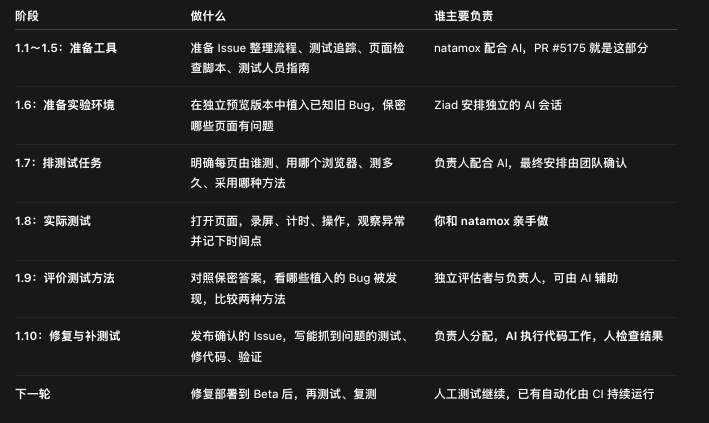
Let's understand the testing Plate currently needs to do according to the three phases of STEP:
STEP Phase | Core Question | Specific Work in Plate |
|---|---|---|
Planning | Clarify what to test, how to test, and who tests | 1.1–1.5, 1.7 Natamox plans, organizes the division-of-labor document, and submits the PR. |
Acquition | What to prepare to start test resource preparation | 1.6, 1.5 Ziad injects known bugs, prepares the test environment, and installs everything. Natamox prepares the page inspection scripts and testing methods. |
Measurement | How is the product performing, and are the testing methods good enough | 1.8–1.10 Start testing, publish issues, and evaluate testing methods |
Laying it out this way feels much clearer, and it also helps me understand what I need to do next (wait for Ziad to wake up, assign the work, then go do actual testing, record bugs on screen, and submit issues).
I find this approach of injecting bugs in advance quite interesting. It's not just about letting us find them—it also helps the team judge whether the testing methods have the ability to discover problems. Checking "does this feature behave correctly" is evaluating the product. Comparing how many known problems different exploration methods can discover is evaluating the testing process.
What's more interesting is that the test plan also records the hash of each regression test's source code. When the Agent prepares for the next round of testing, it reads the previous round's records, then uses pnpm kb to get the current test's hash and CI coverage. If the hash has changed, it means this test has been modified and needs to be re-confirmed that it can still detect the original bug. The confirmation method is to make the modified test fail on the pre-fix code due to the original problem, and pass after the fix. Once verification is complete, update the hash in the record; otherwise, the issue remains on the retest list.
Tail
The STEP model is a guiding philosophy for testing, but I feel that in many cases you don't need to over-apply this philosophy—many things just fall into place naturally. Is it empiricism? You just know after doing it enough (perhaps these theories were summarized from practice). I feel what deserves more attention is how to get the Agent to do testing well while writing code, to build a good testing process, and to make the Agent's code more trustworthy. The great lauren has done this well, and you can learn a lot from the video. The current team's view on testing is to make fully automated testing the long-term goal, without manual testing.
I think writing articles is something that needs to be sustained, especially in today's massive information flow—writing articles quietly is what better sparks your own thinking. Every time Astra becomes numbing, writing articles can wake up your brain, even if it's just writing about daily life.
Comments
No comments yet. Say something?